The United Football League (UFL) has officially set the stage for a transformative 2026 season. With the opening kickoff scheduled for Friday, March 27, the league is doubling down on its identity as professional football’s premier “innovation laboratory.”
Co-owner Mike Repole didn’t mince words during the announcement: “The UFL exists to innovate. If we’re not making the game more exciting and fan-focused, we’re not doing our job.” From scoring overhauls to punting bans, these changes are designed to punish conservative play and reward high-stakes decision-making.
Here is a breakdown of the new rules and how they will reshape the betting landscape this spring.
The Four-Point Field Goal
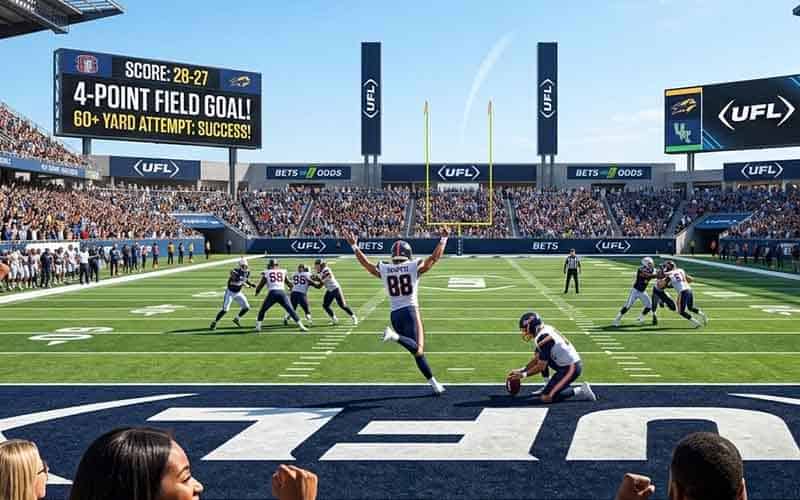
In perhaps the most radical scoring change in modern football history, any successful field goal from 60 yards or beyond will now be worth four points.
The Rule: Kickers must successfully convert from at least the 60-yard mark. For context, the NFL record is 66 yards, but the UFL is betting that the extra incentive will encourage coaches to let their big-legged specialists take the risk rather than punting or trying a “Hail Mary.”
Betting Impact: This is a nightmare for “key number” spread bettors. Traditionally, a 3-point field goal creates predictable margins. Now, a late-game drive that stalls at the 43-yard line (a 60-yard attempt) could turn an 8-point deficit into a 4-point game, or turn a “push” into a cover. Expect live wagering in the fourth quarter and betting during the UFL Playoffs to be more volatile than ever.
No Punting Inside the 50
To eliminate “non-action” plays, the UFL has banned punting once a team crosses the 50-yard line (the opponent’s 49 and in).
The Rule: UFL teams must either go for it on fourth down or attempt a field goal. This rule remains in effect even if a penalty or sack pushes the offense back behind midfield, provided the ball was “made ready for play” inside the 50. The only exception is during the final two minutes of either half.
Betting Impact: This is a massive boost for the Over. By removing the option to pin an opponent deep, the UFL is essentially forcing teams to stay aggressive. This leads to more scoring opportunities and better field position for the opposing team if a fourth-down conversion fails.
The End of the “Tush Push”
While the NFL continues to debate the merits of the Philadelphia Eagles’ favorite short-yardage play, the UFL has officially banned it.
The Rule: Players are prohibited from getting behind the quarterback and physically pushing him forward into the line of scrimmage.
Betting Impact: This creates a significant “wait-and-see” for short-yardage touchdown scorers. Teams that relied on brute-force QB sneaks will now have to get creative. Defenses gain a slight edge on 4th-and-inches, potentially leading to more turnovers on downs.
One Foot Inbounds On Receptions
Adopting the NCAA standard, the UFL will now only require one foot inbounds for a catch to be ruled legal.
The Rule: Mirroring college football, a receiver needs only a single toe-tap to secure a catch along the sidelines or in the back of the end zone.
Betting Impact: This change is designed to juice passing props and Anytime Touchdown Scorer markets. Receivers who were “NFL-caliber” but struggled with the two-foot rule will suddenly see their production skyrocket. It also makes “sideline” catches more frequent, extending drives and aiding the Over.
Three-Attempt Overtime Shootout
The UFL is sticking with its “shootout” style overtime but refining the process.
The Rule: Each team gets three alternating attempts from the 5-yard line. If the tie remains, they continue alternating until a winner emerges. Notably, the home-team choice has been replaced by a standard coin toss.
Betting Impact: This format makes a “Tie” (Draw) bet impossible and heavily favors teams with high-percentage red zone offenses. For spread bettors, overtime will feel like a coin flip, as a single missed 5-yard conversion can end the game instantly.
Revised Kickoff & Touchback Logic
The “Landing Zone” is getting a makeover to increase returns and reduce touchbacks in one of the most intriguing rule changes for the 2026 season.
The Rule: The kickoff moves to the 30-yard line. Most touchbacks (balls kicked into the end zone) will now result in the ball being placed at the 40-yard line, which is a massive penalty compared to the standard 20- or 25-yard line.
Betting Impact: Field position is king. Starting a drive at the 40-yard line significantly increases the statistical probability of a scoring drive. Look for first-half totals to trend higher as teams adjust to these shorter fields.